
What’s at stake? Why a shared approach to family is a goal worth reaching for!
There are many forces working against parents who are both interested in redesign their work so they can share in the care of their children.
We were honored to have 1MFWF ask us to write about how couples can overcome these barriers and create a “team at home.” We also used this opportunity to put a spotlight on some of the wonderful shared care families we know.
Over the years, a number of authors have written about Shared Care, and Kristin Maschka, one of these wonderful authors, recently joined us for a Thursdays with ThirdPath webinar. Kristin’s book, This is Not How I Thought it Would Be – Redesigning Motherhood, does a great job describing how she and her husband first got stuck in traditional work and family roles, but then learned how to work together to create a shared approach they are still practicing today.
Below are some of the things Kristin believes she and her husband gained by switching to Shared Care. You can also click on the YouTube video to watch a recording of our recent webinar with her.
“I knew what I would lose. I’d lose my marriage – Maybe not literally, but something vital at its core. David and I got married as equals, as best friends, as partners. When we were married, we vowed to ‘be true to the pursuit of the dreams and goals we both share. The dream we shared now was of a family life with everyone home for dinner, with time for our relationship with each other. We wanted a family life that would allow us to share the family responsibilities so that we both had time to pursue our own dreams and both had a relationship with Kate. How could we hope to have our marriage stand the test of time if we gave up on that vow to be true to the dreams we both shared? I would always carry some level of resentment, and he would always feel some defensiveness. If we gave up on the idea that we could share responsibility for our family, effectively we would be giving up on a core value in our marriage.”
“What would David lose? – I didn’t want David to miss out on the richness of the relationship I had with Kate. A richness that came from putting a cold washcloth on her feverish forehead, from reading and giggling about stories in her bed at night, and, yes, from the times she drove me crazy and I yelled and then said I was sorry and she hugged me anyway. I didn’t want David to find many years later that he didn’t know his own child, had missed her childhood and couldn’t have a meaningful conversation with her. I wanted more for him. So badly it brought me to tears. And I was pretty sure he wanted it too.”
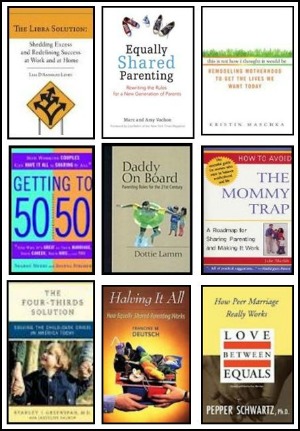
Want to learn more about Shared Care? We highly recommend any of these books:
The Libra Solution, Shedding Excess and Redefining Success at Work and at Home, Lisa D’Annolfo Levey (2012)
Equally Shared Parenting, Rewriting the Rules for a New Generation of Parents, Marc and Amy Vachon (2011)
This is Not How I Thought It Would Be, Remodeling Motherhood To Get The Lives We Want Today, Kristin Maschka (2009)
Getting to 50-50, How Working Couples Can Have it All by Sharing it All, Sharon Lerner (2009)
Daddy On Board, Parenting Roles for the 21st Century, Dottie Lamm (2007)
How to Avoid The Mommy Trap, A Road Map for Sharing Parenting and Making it Work, Julie Shields (2003)
The Four-Thirds Solution, Solving the Childcare Crisis in America Today, Stanley Greenspan (2002)
Halving it All, How Equally Shared Parenting Works, Francine Deutsch (2000)
Love Between Equals, How Peer Marriage Really Works, Pepper Schwartz (1995)
Check out the many resources we have for families. Let us help you design the work/family solution that is right for you!